 4)
Hole superconductivity in oxides
, Sol.St. Comm. 69, 987 (1989).
(w/ S. Tang)
4)
Hole superconductivity in oxides
, Sol.St. Comm. 69, 987 (1989).
(w/ S. Tang)
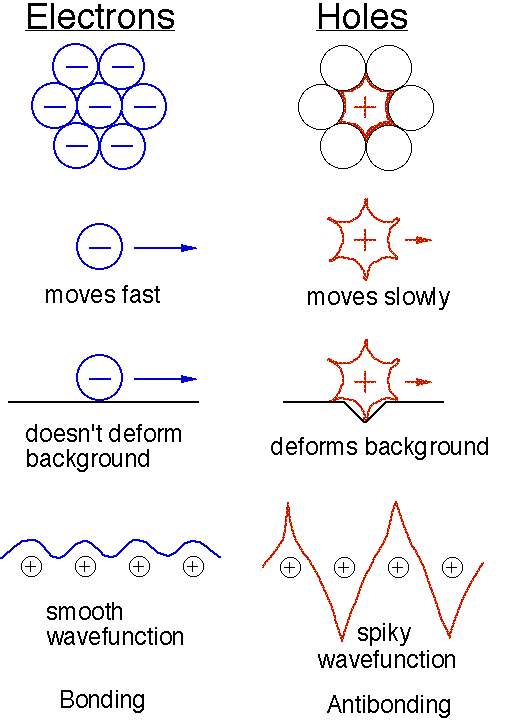 The theory of hole superconductivity (also known
in some circles as 'The holistic
theory of superconductivity') asserts that superconductivity
can only occur when 'hole' carriers exist in the normal state of
a metal. A 'hole' is the
absence of an electron, and hole carriers exist when an electronic
energy band is almost full.
Holes
are different from
electrons
, as the picture to the right clearly shows.
A hole in a full band has difficulty
propagating due to the disruption it causes in its environment.
Superconductivity occurs due to pairing
of hole carriers, and is driven by the fact that paired holes
can propagate more easily (have a smaller effective mass) than single
holes. As a consequence, their
kinetic energy is lowered.
In contrast, single electrons can move easily and so they
don't pair. 'Dynamic Hubbard models'
describe the different physics of
electron and hole carriers in metals.
The different mobility of holes and electrons can
be illustrated by a garage analogy.
The reason for the increased mobility of holes upon pairing is that
they 'undress'
when they pair, and turn into electrons.
This leads to a new understanding of
superconductors, that a superconductor is a
giant atom.
If the theory is correct it implies that the electron-phonon
interaction is irrelevant to superconductivity, that
BCS theory is incorrect
and that
London theory is incorrect.
The theory also
explains the Meissner effect
and predicts a
Spin Meissner effect.
The theory of hole superconductivity (also known
in some circles as 'The holistic
theory of superconductivity') asserts that superconductivity
can only occur when 'hole' carriers exist in the normal state of
a metal. A 'hole' is the
absence of an electron, and hole carriers exist when an electronic
energy band is almost full.
Holes
are different from
electrons
, as the picture to the right clearly shows.
A hole in a full band has difficulty
propagating due to the disruption it causes in its environment.
Superconductivity occurs due to pairing
of hole carriers, and is driven by the fact that paired holes
can propagate more easily (have a smaller effective mass) than single
holes. As a consequence, their
kinetic energy is lowered.
In contrast, single electrons can move easily and so they
don't pair. 'Dynamic Hubbard models'
describe the different physics of
electron and hole carriers in metals.
The different mobility of holes and electrons can
be illustrated by a garage analogy.
The reason for the increased mobility of holes upon pairing is that
they 'undress'
when they pair, and turn into electrons.
This leads to a new understanding of
superconductors, that a superconductor is a
giant atom.
If the theory is correct it implies that the electron-phonon
interaction is irrelevant to superconductivity, that
BCS theory is incorrect
and that
London theory is incorrect.
The theory also
explains the Meissner effect
and predicts a
Spin Meissner effect.
Materials: The high temperature superconductivity of the cuprates (hole-doped and electron-doped ), the arsenides, magnesium diboride, transition metal elements, and elements under high pressure have a natural explanation within this theory.
1) Hole superconductivity , Phys.Lett. A 134, 451 (1989).
2) Finite systems studies and the mechanism of high Tc , in "Mechanisms of High Temperature Superconductivity" (Proceedings of the 2nd. NEC Symposium, Hakone, Japan, October 1988)), Springer, Berlin, 1989, p. 34.
3)
Effective interactions in an oxygen hole metal
, Phys.Rev. B40, 2179 (1989).
(w/ S. Tang)
4)
Hole superconductivity in oxides
, Sol.St. Comm. 69, 987 (1989).
(w/ S. Tang)
5) Superconductivity in an oxygen hole metal , Phys.Rev. B41, 2049 (1990). (w/ F. Marsiglio)
6) Singlet pairs, covalent bonds, superexchange and superconductivity, Phys.Lett.A136, 163 (1989).
7) Superconducting state in an oxygen hole metal , Phys.Rev. B39, 11515 (1989). (w/ F. Marsiglio)
8) Bond charge repulsion and hole superconductivity , Physica C 158, 326 (1989).
9) Hole superconductivity in oxides and other materials , in "High Temperature Superconductors" (Proc. of the Xth Winter Meeting on Low Temperature Physics, Cocoyoc, Mexico, January 1989), World Scientific, Singapore, 1989, p. 43.
10) Coulomb attraction between Bloch electrons , Phys.Lett.A 138, 83 (1989).
11) Tunneling asymmetry: a test of superconductivity mechanisms , Physica C 159, 157 (1989). (w/ F. Marsiglio)
12) On the dependence of superconducting Tc on carrier concentration , Phys.Lett. A 140, 122 (1989). (w/ F. Marsiglio)
13) Hole conductors and superconductors , Mat.Res.Soc.Symp.Proc.Vol.156, 349 (1989).
14) Hole superconductivity : review and some new results , Physica C 162-164, 591, (1989). (w/ F. Marsiglio)
15)
BCS theory of hole superconductivity : quasi-two-dimensional model
,
Physica C 162-164, 1451 (1989).
(w/ F. Marsiglio)

16) Hole superconductivity: the strong coupling limit , Physica C161, 185 (1989); Erratum: Physica C 218, 504 (1993).
17) Superconductivity in oxides: from strong to weak coupling , Physica C 165, 71 (1990). (w/ F. Marsiglio)
18) Hole superconductivity and the high Tc oxides , Phys.Rev. B41, 6435 (1990). (w/ F. Marsiglio)
19) Empirical estimate of a Coulomb matrix element of relevance to superconductivity , Chem.Phys.Lett. 171, 161 (1990).
20) Hole superconductivity in oxides: a two-band model , Phys.Rev. B43,424(1991). (w/ F. Marsiglio)
21) Hole superconductivity in the dilute limit , Physica C 171, 554 (1990). (w/ F. Marsiglio)
22) Prediction for the change in lattice constants of electron-doped high-Tc superconductors under hydrostatic pressure based on the observed pressure dependence of Tc , Physica C 172, 265 (1990). (w/ F. Marsiglio)
23) Pairing of holes in a tight binding model with repulsive Coulomb interactions , Phys.Rev. B43, 11400 (1991).
24) Electron-hole asymmetry: the key to superconductivity , (Miami proc., 1991); in "High-Temperature Superconductivity", ed. by J. Ashkenazi et al, Plenum Press, New York, 1991, p.295.
25) Coherence effects in hole superconductivity , Phys.Rev. B44, 11960 (1991). (w/ F. Marsiglio)
26) Hole superconductivity in a generalized two-band model , Phys.Rev. B45, 12556 (1992). (w/ X.Q. Hong)
27) Bose decondensation versus pair unbinding in short coherence length superconductors , Physica C 179, 317 (1991).
28) London penetration depth in hole superconductivity , Phys.Rev. B45, 4807 (1992). (w/ F. Marsiglio)
29) Why is photoemission better than inverse photoemission for studying high Tc oxides? , Physica C 182, 277 (1991).
30) Effect of local potential variations in the model of hole superconductivity, Physica C 194, 119 (1992).
31) Normal state properties of high Tc oxides , Physica C 195, 355 (1992). (w/ F. Marsiglio)
32) Apparent violation of the conductivity sum rule in certain superconductors, Physica C 199, 305 (1992).
33) Superconductivity in the transition metal series , Phys. Rev. B46, 14702 (1992). (w/ X.Q. Hong)
34) Pairing in a generalized Holstein model for small polarons , Phys. Lett. A. 168, 305 (1992).
35) Superconductors that change color when they become superconducting, Physica C 201, 347 (1992).
36) Polaronic superconductivity in the absence of electron-hole symmetry, Phys.Rev. B47, 5351 (1993).
37,38,39) Electron and hole hopping amplitudes in a diatomic molecule. (I) ; II. Effect of radial correlations ; III: p orbitals . Phys.Rev. B48, (1993): 3327, 3340, 9815.
40) Color change and other unusual spectroscopic features predicted by the model of hole superconductivity , (Santa Fe Conf., March 1993), J. Phys. Chem. Solids 54, 1101 (1993).
41) Inapplicability of the Hubbard model for the description of real strongly correlated electrons , (SCES93), Physica B 199&200, 366 (1994).
42) Superconductivity from electron-phonon interactions in the absence of electron-hole symmetry , Physica B 199&200, 338 (1994). (w/ F. Marsiglio)
43) Superconductivity from retarded interactions in the presence of electron- hole asymmetry , Phys.Rev. B 49, 1366 (1994). (w/ F. Marsiglio)
44) Thermoelectric power of superconductive tunnel junctions , Phys. Rev. Lett. 72, 558 (1994).
45) Tunneling and thermoelectric effect in generalized tunnel junctions in the presence of electron-hole asymmetry , Phys. Rev. B 50, 3165 (1994).
46) Electron-hole asymmetric polarons , in "Polarons and Bipolarons in high Tc Superconductors and Related Materials", ed. by E.K.H. Salje, A.S. Alexandrov and W.Y. Liang, Cambridge University Press, Cambridge, 1995, p. 234
47) Role of reduction process in the transport properties of electron-doped oxide superconductors, , Physica C 243, 319 (1995).
48) Pairing in a tight binding model with occupation-dependent hopping rate: exact diagonalization study , Phys.Rev. B. 52, 16155 (1995). (w/ H.Q. Lin)
49) Correlations between normal-state properties and superconductivity. Phys. Rev. B 55, 9007 (1997).
50) Thermoelectric effect in superconductive tunnel junctions Phys. Rev. B 58, 8727 (1998)
51) Slope of the superconducting gap function in $Bi_2Sr_2CaCu_2O_{8+\delta}$ measured by vacuum tunneling spectroscopy Phys. Rev. B 59 , 11962 (1999).
52) Where is 99% of the condensation energy of Tl_2Ba_2CuO_y coming from? cond-mat/9908322, Physica C 331, 150 (2000) (w/ F. Marsiglio)
53) Optical sum rule violation, superfluid weight and condensation energy in the cuprates With F. Marsiglio , cond-mat/0004496, Phys. Rev. B 62, 15131 (2000).
54) Anisotropic penetration depth and optical sum rule violation in La2-xSrxCuO4 With F. Marsiglio , cond-mat/0005002, presented at the 6th International Conference on Materials and Mechanisms of Superconductivity, Houston, February 2000, Physica C 341-348, 2217 (2000).
55) Hole superconductivity from kinetic energy gain ,cond-mat/0005033, presented at the 6th International Conference on Materials and Mechanisms of Superconductivity, Houston, February 2000, Physica C 341-348, 213 (2000).
56) Superconductivity from Undressing , cond-mat/0007115, Phys.Rev.B 62, 14487 (2000)
57) Superconductivity from Undressing. II. Single Particle Green's Function and Photoemission in Cuprates , cond-mat/0007328, Phys.Rev.B 62, 14498 (2000)
58) Consequences of charge imbalance in superconductors within the theory of hole superconductivity , cond-mat/0012517, Phys.Lett.A 281, 44 (2001)
59) Superconductivity from Hole Undressing , cond-mat/0102136, Physica C 364-365, 37 (2001). Presented at the Third International Conference on New Theories, Discoveries, and Applications of Superconductors and Related Materials (New3SC-3), Hawaii, January 2001.
60) Hole Superconductivity in $Mg B_2$: a high $T_c$ cuprate without Cu , cond-mat/0102115 , Phys. Lett. A282, p.392-398 (2001).
61) Electron-Phonon or Hole Superconductivity in $MgB_2$? , With F. Marsiglio , cond-mat/0102479 (2001), Phys. Rev. B 64, 144523 (2001).
62) Hole Superconductivity in MgB_2, Cuprates, and Other Materials , cond-mat/0106310 (2001) (Los Alamos) in "Studies of High Temperature Superconductors", ed. by A. Narlikar, Nova Sci. Pub., New York, 2002, Vol. 38, p. 49.
63) Comment on "Discovery of microscopic electronic inhomogeneity in the high-$T_c$ superconductor $Bi_2Sr_2CaCu_2O_{8+x}$", cond-mat/0107347 , cond-mat/0107372 (2001).
64) Dynamic Hubbard Model , Phys. Rev. Lett. 87, 206402 (2001).
65) Why holes are not like electrons: A microscopic analysis of the differences between holes and electrons in condensed matter , Phys.Rev. B 65, 184502 (2002), cond-mat/0109385 (2001).
66) Quantum Monte Carlo and exact diagonalization study of a dynamic Hubbard model , cond-mat/0201005 (2002), Phys.Rev. B65, 214510 (2002).
67) The True Colors of Cuprates , Science 295, 2226 (2002)
68) Quasiparticle undressing in a dynamic Hubbard model: exact diagonalization study , cond-mat/0205006 (2002), Phys.Rev. B66, 064507 (2002).
69) Electronic dynamic Hubbard model: exact diagonalization study , cond-mat/0207369 (2002), Phys.Rev. B67, 035103 (2003).
70) Quasiparticle undressing: a new route to collective effects in solids , cond-mat/0211642 (2002), in "Concepts in Electron Correlation", ed. by A.C. Hewson and V. Zlatic, Kluwer Academic Publishers, Dordrecht, 2003, p. 371.
71) Electron-hole asymmetry and superconductivity , cond-mat/0211643, Phys.Rev.B 68, 012510 (2003).
72) Electron-hole asymmetry is the key to superconductivity , cond-mat/0301610, New3SC-4 meeting, San Diego, Jan. 16-21 2003, Int. J. Mod. Phys. B 17, 3236 (2003)
73) Superconductors as giant atoms predicted by the theory of hole superconductivity , cond-mat/0301611 , Phys.Lett.A 309, 457 (2003).
74) The Lorentz force and superconductivity , cond-mat/0305542, Phys.Lett.A 315, 474 (2003).
75) Superconductors as giant atoms: qualitative aspects , cond-mat/0305574, AIP Conf. Proc. 695(1) 21 (17 Dec 2003).
76) Charge expulsion and electric field in superconductors , cond-mat/0308604, Phys.Rev. B 68, 184502 (2003).
77) Dynamic Hubbard Model: Effect of Finite Boson Frequency , F. Marsiglio, R. Teshima, JEH, cond-mat/0307594 (2003), Phys.Rev. B 68, 224507 (2003).
78) Predicted electric field near small superconducting ellipsoids , cond-mat/0312618 (2003), Phys.Rev.Lett. 92, 016402 (2004).
79) Electrodynamics of superconductors , cond-mat/0312619 (2003), Phys.Rev. B 69, 214515 (2004).
80) Spin currents in superconductors , cond-mat/0406489 (2004), Phys.Rev. B 71, 184521 (2005).
81) The fundamental role of charge asymmetry in superconductivity , cond-mat/0407642 (Los Alamos), J. Phys. Chem. Solids 67, p.21 (2006), SNS'2004, Sitges,Spain, July 11-16,2004
82) Reply to ``Comment on `Charge expulsion and electric field in superconductors' ' ', by T. Koyama , cond-mat/0412091 (2004), Phys.Rev. B 70, 226504 (2004).
83) Why holes are not like electrons. II. The role of the electron-ion interaction. , Phys.Rev. B 71, 104522 (2005), cond-mat/0504013 (2005).
84) Explanation of the Tao effect, cond-mat/0502626 (2005), Phys.Rev.Lett. 94, 187001 (2005).
85) Spin currents, relativistic effects and the Darwin interaction in the theory of hole superconductivity , cond-mat/0508471 (2005), Phys.Lett. A 345, 453 (2005).
86) Ionizing radiation from superconductors in the theory of hole superconductivity, J. Phys. Cond. Matter 19, 125217 (2007).
87) Do superconductors violate Lenz's law? Body rotation under field cooling and theoretical implications, Phys.Lett. A366, 615 (2007).
88) Spin Meissner Effect in Superconductors and the Origin of the Meissner Effect , arXiv:0710.0876 (2007), Europhys. Lett. 81, 67003 (2008).
89) Electrodynamics of spin currents in superconductors , arXiv:0803.1198 (2008), Ann. Phys. (Berlin) 17, 380 (2008).
90) The missing angular momentum of superconductors , arXiv:0803.2054, (2008), J. Phys. Cond. Matt. 20, 235233 (2008).
91) Hole superconductivity in Arsenic-Iron compounds . With F. Marsiglio , arXiv:0804.0002, (2008), Physica C 468, 1047 (2008).
92) Charge expulsion, Spin Meissner effect, and charge inhomogeneity in superconductors , arXiv:0810.5127, (2008), Journal of Superconductivity and Novel Magnetism 22, 131 (2009).
93) Why holes are not like electrons. III. How holes in the normal state turn into electrons in the superconducting state, arXiv:0901.3612 (2009), Int. J. Mod. Phys. B 23, 3035 (2009), Erratum.
94) BCS theory of superconductivity: it is time to question its validity, Physica Scripta 80 (2009) 035702.
95) Explanation of the Meissner Effect and Prediction of a Spin Meissner Effect in Low and High $T_c$ Superconductors, Physica C 470, S955 (2010).
96) Why non-superconducting metallic elements become superconducting under high pressure. With J.J. Hamlin, Physica C 470, S937 (2010).
97) Electromotive forces and the Meissner effect puzzle, Journal of Superconductivity and Novel Magnetism 23, 309 (2010) dx.doi.org/10.1007/s10948-009-0531-4
98) A new basis set for the description of electrons in superconductors , Physics Letters A 373, 1880 (2009) dx.doi.org/doi:10.1016/j.physleta.2009.03.058.
99) Why holes are not like electrons. IV. Hole undressing and spin current in the superconducting state , Int. Jour. Mod. Phys. B 24, 3627 (2010), arXiv 1002.2688.
100) Hole core in superconductors and the origin of the Spin Meissner effect, Physica C 470, 635 (2010) dx.doi.org/10.1016/j.physc.2010.06.005.
101)
Spin-split states in aromatic molecules and superconductors,
arXiv:1007.2813,
Phys. Lett. A 374, 3777 (2010).
102)
Double-valuedness of the electron wave function and rotational zero-point motion
of electrons in rings,
arXiv:1007.2834,
Mod. Phys. Lett. B 24, 2201 (2010).
103)
Kinetic energy driven superconductivity, the origin of the Meissner effect, and the reductionist frontier,
arXiv:1103.3912 (2011), Int. J. Mod. Phys. B 25, 1173 (2011).
104)
Materials and mechanisms of hole superconductivity,
arXiv:1104.1624 (2011),
Physica C 472, 78 (2012).
105)
Meissner effect, Spin Meissner effect and charge expulsion in superconductors ,
arXiv:1106.5311 (2011),
J. Sup. Nov. Mag. 26, 2239 (2013).
106)
Kinetic energy driven superconductivity and superfluidity
,
arXiv:1109.0504 (2011), Mod. Phys. Lett. B 25, 2219 (2011).
107)
The origin of the Meissner effect in new and old superconductors
,
arXiv:1201.0139 (2011), Physica Scripta 85, 035704 (2012).
108)
Experimental consequences of predicted charge rigidity of superconductors,
arXiv:1201.0139,
Physica C 478, 42 (2012).
109)
Correcting 100 years of misunderstanding: electric fields in superconductors, hole superconductivity, and the Meissner effect,
arXiv:1202.1851,
J Supercond Nov Magn 25, 1357 (2012).
110)
Kinetic energy driven superfluidity and superconductivity and the origin of the Meissner effect,
arXiv:1210.1578 (2012), Physica C 493, 18 (2013).
111)
Prediction of unexpected behavior of the mean inner potential of superconductors,
arXiv:1301.4999,
Physica C 490, 1 (2013)
.
112)
Dynamic Hubbard model: kinetic energy driven charge expulsion,
charge inhomogeneity, hole superconductivity, and Meissner effect,
arXiv:1302.4178 (2013), Physica Scripta 88, 035704 (2013).
113)
Apparent increase in the thickness of superconducting particles at low temperatures
measured by electron holography,
arXiv:1303.2710 (2013),
Ultramicroscopy 133, 67-71 (2013).
114) Charge expulsion, charge inhomogeneity and phase separation in dynamic Hubbard models, arXiv:1307.6526,
Phys. Rev. B 87, 184506 (2013).
115)
Superconductivity, diamagnetism, and the mean inner potential of solids,
arXiv:1307.4438 (2013)
116) The London moment: what a rotating superconductor reveals about superconductivity, arXiv:1310.3834 (2013), Physica Scripta 89, 015806 (2014).
117) Dynamic Hubbard model for solids with hydrogen-like atoms, arXiv:1406.7332 (2014), Phys. Rev. B 90, 104501 (2014).
118) Effect of orbital relaxation on the band structure of cuprate superconductors and implications for the superconductivity mechanism, arXiv:1407.0042 (2014), Phys. Rev. B90, 184515 (2014).
119) Proposed experimental test of an alternative electrodynamic theory of superconductors, arXiv:1409.0869 (2014), Physica C 508, 21 (2015).
120) Hole superconductivity in H2S and other sulfides under high pressure, with F. Marsiglio, arXiv:1412.6251 (2014), Physica C 511, 45 (2015).
121) Absence of Josephson coupling between certain superconductors, arxiv: 1502.07059 (2015), Europhys. Lett. 109, 67005 (2015).
122) Dynamics of the normal-superconductor phase transition and the puzzle of the Meissner effect , arxiv: 1504.05190 (2015), Annals of Physics 362, 1 (2015).
123) On the dynamics of the Meissner effect, arxiv: 1508.03307 (2015), Physica Scripta 91, 035801 (2016).
123') Corrigendum on "On the dynamics of the Meissner effect", arXiv:1609.06299 (2016), Physica Scripta 91, 099501 (2016).
124) The Bohr superconductor, arxiv: 1512.05014 (2015), Europhys. Lett. 113, 37001 (2016).
125) The disappearing momentum of the supercurrent in the superconductor to normal phase transformation, arxiv:1604.03565 (2016), Europhys. Lett. 114, 57001 (2016) .
126) On the reversibitity of the Meissner effect and the angular momentum puzzle, arXiv:1604.07443 (2016), Annals of Physics 373, 230 (2016).
127) Proposed experimental test of the theory of hole superconductivity, Physica C 525, 44 (2016).
128) What is the speed of the supercurrent in superconductors?, arXiv:1605.09469 (2016).
129) Momentum of superconducting electrons and the explanation of the Meissner effect, arXiv:1609.08451 (2016), Phys. Rev. B 95, 014503 (2017).
130) Entropy generation and momentum transfer in the superconductor-normal and normal-superconductor phase transformations and the consistency of the conventional theory of superconductivity, arxiv: 1703.04404 (2017), Int. J. Mod. Phys. Vol. 32, 1850158 (2018).
131) Why only hole conductors can be superconductors, Proc. SPIE 10105, Oxide-based Materials and Devices VIII, 101051V (March 7, 2017), arXiv:1703.09777.
132) Towards an understanding of hole superconductivity, Springer Series in Materials Science 255, 99 (2017)---- arXiv:1704.07452.
133) Spinning Superconductors and Ferromagnets, Acta Physica Polonica A 133, 350 (2018)
134) Moment of inertia of superconductors, arXiv:1808.02857 (2018), Physics Letters A 383, 83 (2019)
135) Defying inertia: how rotating superconductors generate magnetic fields , arXiv:1812.06780 (2018), Annalen der Physik (2019).
136) Understanding electron-doped cuprate superconductors as hole superconductors , with F. Marsiglio, arXiv:1904.09164 (2019), Physica C 564, 29 (2019)
137) Hole superconductivity in infinite-layer nickelates , with F. Marsiglio, arXiv:1909.00509 (2019), Physica C 566, 1353534 (2019)
138) Alfven-like waves along normal-superconductor phase boundaries , arXiv:1906.03083 (2019), Physica C 564, 42 (2019)
139) Thermodynamic inconsistency of the conventional theory of superconductivity, arXiv:1907.11273 (2019), IJMPB (2020).
140) Superconducting materials: the whole story, arXiv:1908.04419 (2019), J Supercond Nov Magn (2019).
141) How Alfven's theorem explains the Meissner effect, arXiv:1909.11443 (2019), MPLB (2020).
142) Inconsistency of the conventional theory of superconductivity, arXiv:1909.12786 (2019), EPL 130, 17006 (2020).
143) Joule heating in the normal-superconductor phase transition in a magnetic field, arXiv:2001.07509 (2020), Physica C 576, 1353687 (2020).
144) Magnetic flux expulsion in a superconducting wire, arXiv:2106.00262 (2021), Physics Letters A 413, 127592 (2021).
145) Hole Superconductivity xOr Hot Hydride Superconductivity, J. Appl. Phys. 130, 181102 (2021)