However we assert that the first London equation, relating the time derivative of the electric current to the electric field, describes the behavior of "perfect metals" but it does not describe the behavior of superconductors.
The only experiment ever performed that appears to support the first London equation, as of December 2003, is an experiment performed by H. London in 1935 (Proc. Roy. Soc. A 155, 102 (1936)). It has never been repeated.
The theory of hole superconductivity
leads to
a
new
description of the electrodynamics of superconductors
and predicts
that 1) The first London equation is incorrect, instead the gradient of the
electrostatic potential should be added to the electric field;
2) an internal electric field exists in
superconductors that does not give rise to an electric current;
3) an externally applied field is screened over a distance
given by the London penetration depth at low temperatures,
rather than by the (much smaller)
Thomas Fermi screening length, 4)
a spontaneous
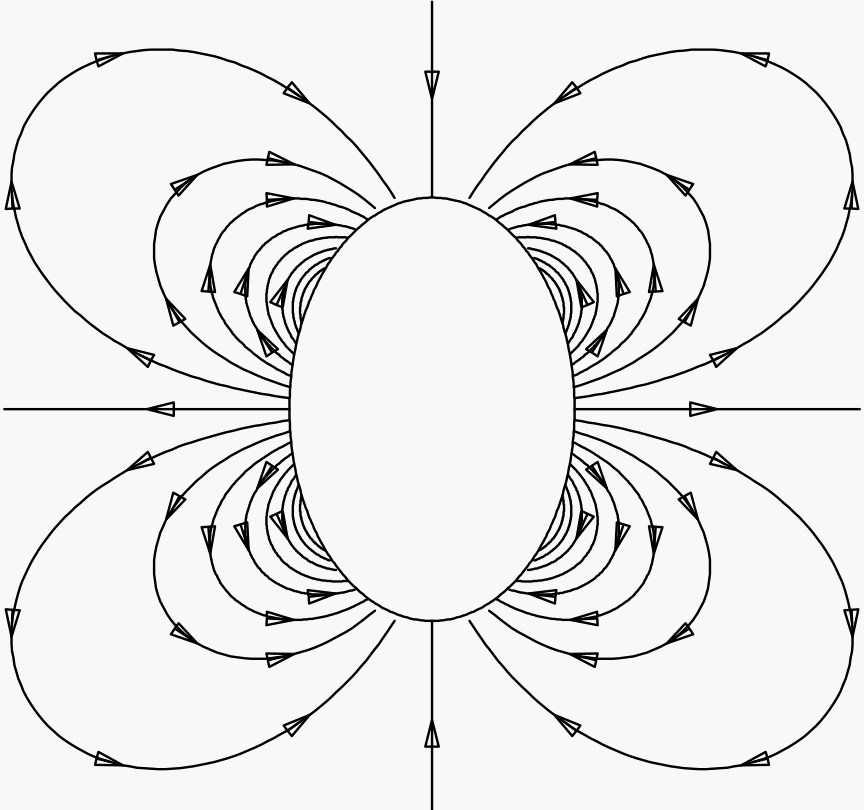
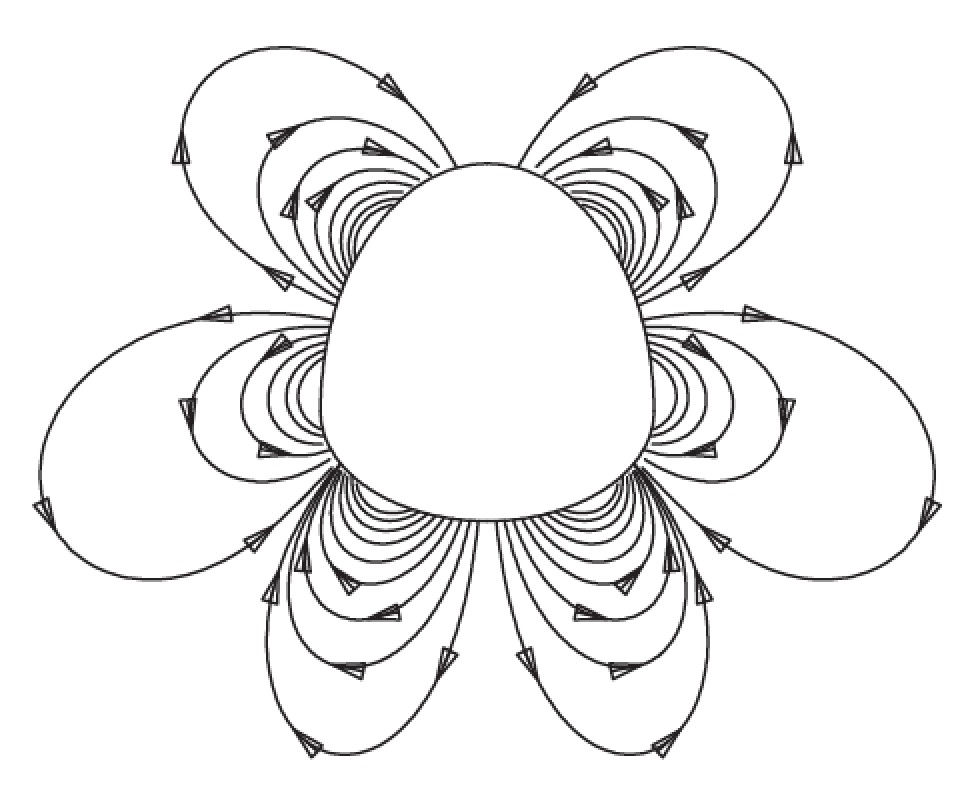
electric field exists superconductors of non-spherical shape.
Electric field lines around particles of different shapes. Lines go out of (into) the surface in regions of low (high) surface curvature.
Charge expulsion and electric field in superconductors , cond-mat/0308604, Phys.Rev. B 68, 184502 (2003).
Predicted electric field near small superconducting ellipsoids , cond-mat/0312618 (2003), Phys.Rev.Lett. 92, 016402 (2004).
Electrodynamics of superconductors , cond-mat/0312619 (2003), Phys.Rev. B 69, 214515 (2004).
Electrodynamics of spin currents in superconductors , arXiv:0803.1198 (2008), Ann. Phys. (Berlin) 17, 380 (2008).
Charge expulsion, Spin Meissner effect, and charge inhomogeneity in superconductors , arXiv:0810.5127, (2008), Journal of Superconductivity and Novel Magnetism 22, 131 (2009).
Experimental consequences of predicted charge rigidity of superconductors, arXiv:1201.0139, Physica C 478, 42 (2012).
Correcting 100 years of misunderstanding: electric fields in superconductors, hole superconductivity, and the Meissner effect, arXiv:1202.1851, J Supercond Nov Magn 25, 1357 (2012).
Proposed experimental test of an alternative electrodynamic theory of superconductors, arXiv:1409.0869 (2014), Physica C 508, 21 (2015) .