 Hole superconductivity from kinetic energy gain
,cond-mat/0005033, presented at the 6th International Conference
on Materials and Mechanisms of Superconductivity, Houston, February 2000,
Physica C 341-348, 213 (2000).
Hole superconductivity from kinetic energy gain
,cond-mat/0005033, presented at the 6th International Conference
on Materials and Mechanisms of Superconductivity, Houston, February 2000,
Physica C 341-348, 213 (2000).
 We have proposed that superconductivity is driven by a
decrease of
kinetic energy of the carriers.
We have proposed that superconductivity is driven by a
decrease of
kinetic energy of the carriers.
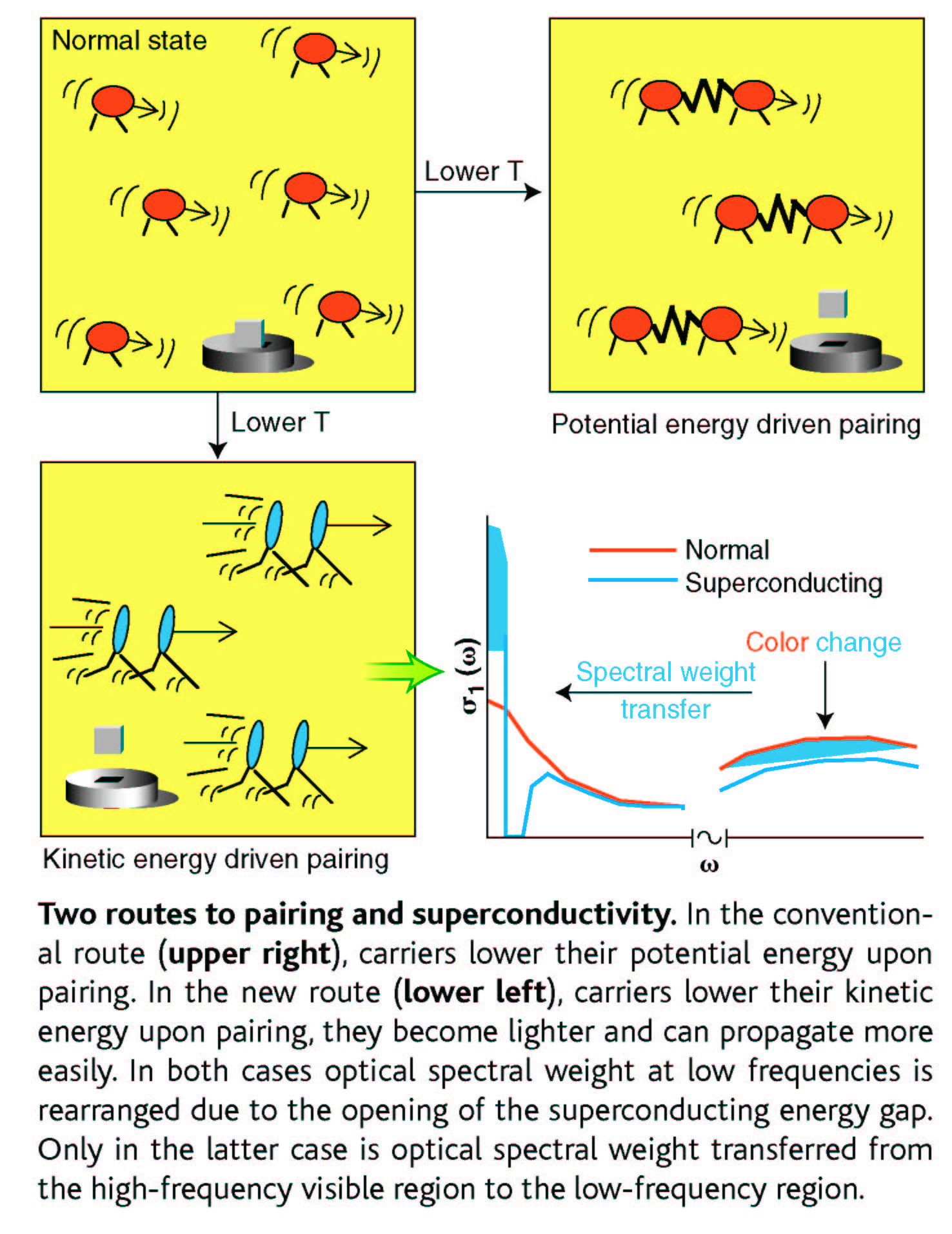
In quantum mechanics, carrier delocalization leads to lowering of kinetic energy. The theory of hole superconductivity predicts that when hole carriers pair they delocalize and lower their kinetic energy. This is the driving force for superconductivity. An experimental signature of it is change in color when the material becomes superconducting.
This is a new and qualitatively different paradigm for superconductivity. In the conventional BCS theory , superconductivity is driven by lowering of potential energy of carriers when they form pairs, and they increase their kinetic energy. Instead, in the new paradigm carriers pair because their kinetic energy decreases, even if there is some cost in potential energy. This is proposed to be the driving force for superconductivity in all materials.
Kinetic energy driven superconductivity explains the Meissner effect.
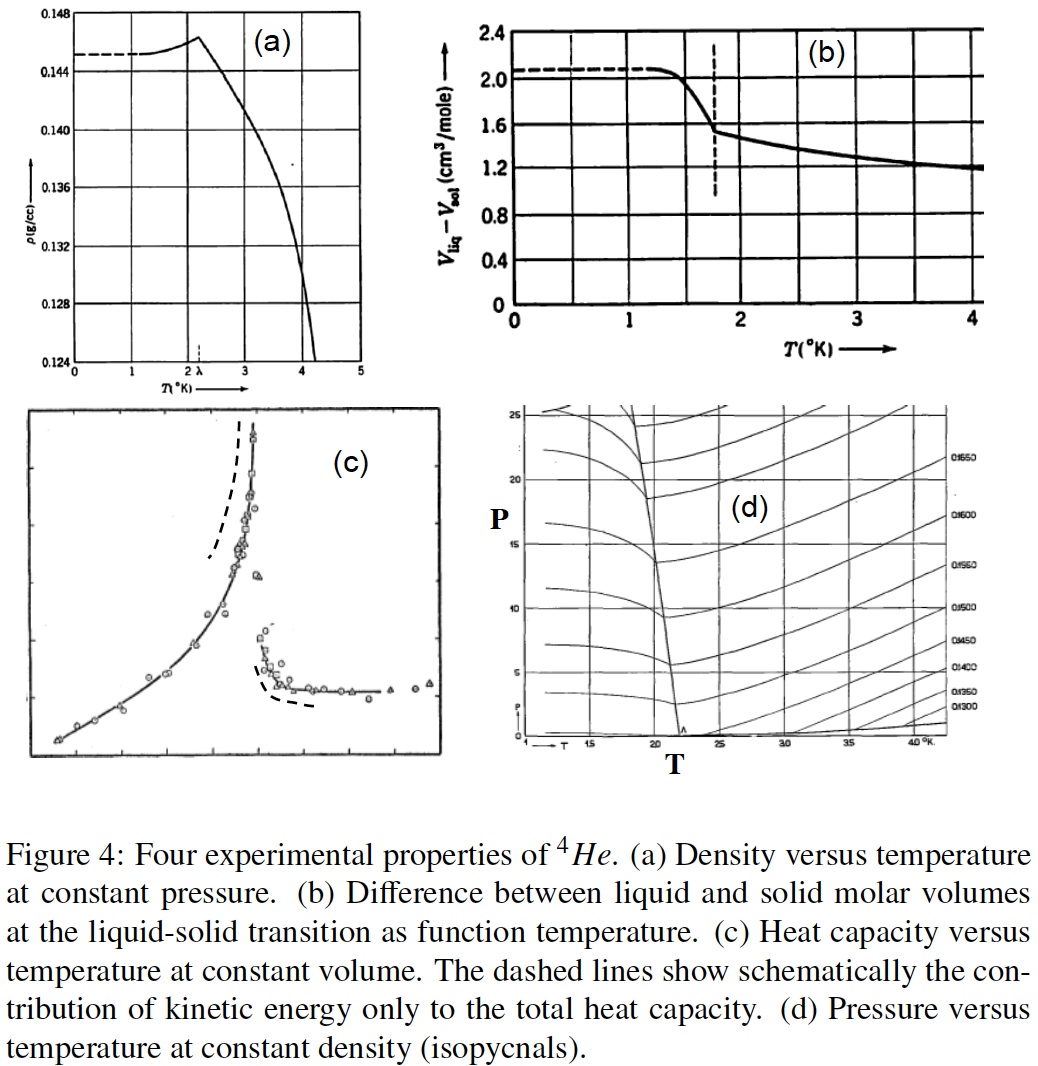
Superfluidity in 4He is also kinetic energy driven. This is clear from many experiments such as shown in the picture to the lower right, but not widely appreciated.
Dynamic Hubbard model: kinetic energy driven charge expulsion, charge inhomogeneity, hole superconductivity, and Meissner effect, arXiv:1302.4178 (2013), Physica Scripta 88, 035704 (2013).
Kinetic energy driven superfluidity and superconductivity and the origin of the Meissner effect, arXiv:1210.1578 (2012), Physica C 493, 18 (2013).
The origin of the Meissner effect in new and old superconductors , arXiv:1201.0139 (2011), Physica Scripta 85, 035704 (2012).
Kinetic energy driven superconductivity and superfluidity , arXiv:1109.0504 (2011), Mod. Phys. Lett. B 25, 2219 (2011).
Kinetic energy driven superconductivity, the origin of the Meissner effect, and the reductionist frontier, arXiv:1103.3912 (2011), Int. J. Mod. Phys. B 25, 1173 (2011).
Quasiparticle undressing: a new route to collective effects in solids , cond-mat/0211642 (2002), Hvar II Proceedngs, (2003).
Quasiparticle undressing in a dynamic Hubbard model: exact diagonalization study , cond-mat/0205006 (2002), Phys.Rev. B66, 064507 (2002).
The True Colors of Cuprates , Science 295, 2226 (2002)
Superconductivity and Ferromagnetism from Effective Mass Reduction , cond-mat/0007453, presented at the 6th International Conference on Materials and Mechanisms of Superconductivity, Houston, February 2000, Physica C 341-348, 211 (2000).
Hole superconductivity from kinetic energy gain
,cond-mat/0005033, presented at the 6th International Conference
on Materials and Mechanisms of Superconductivity, Houston, February 2000,
Physica C 341-348, 213 (2000).
Anisotropic penetration depth and optical sum rule violation in La2-xSrxCuO4 With F. Marsiglio , cond-mat/0005002, presented at the 6th International Conference on Materials and Mechanisms of Superconductivity, Houston, February 2000, Physica C 341-348, 2217 (2000).
Optical sum rule violation, superfluid weight and condensation energy in the cuprates With F. Marsiglio , cond-mat/0004496, Phys. Rev. B 62, 15131 (2000).
Where is 99% of the condensation energy of Tl_2Ba_2CuO_y coming from? With F. Marsiglio , cond-mat/9908322, Physica C 331, 150 (2000).
Color change and other unusual spectroscopic features predicted by the model of hole superconductivity , J. Phys. Chem. Solids 54, 1101 (1993).
Superconductors that Change Color when they Become Superconducting. Physica C201, 347 (1992).
Apparent violation of the conductivity sum rule in certain superconductors, Physica C199, 305 (1992).