The following papers describe
our recent work on dynamic Hubbard models:
Effect of orbital relaxation on the band structure of cuprate superconductors and implications for the superconductivity mechanism, arXiv:1407.0042 (2014), Phys. Rev. B90, 184515 (2014)
Dynamic Hubbard model for solids with hydrogen-like atoms, arXiv:1406.7332 (2014), Phys. Rev. B 90, 104501 (2014).
Charge expulsion, charge inhomogeneity and phase separation in dynamic Hubbard models, arXiv:1307.6526, Phys. Rev. B 87, 184506 (2013) .
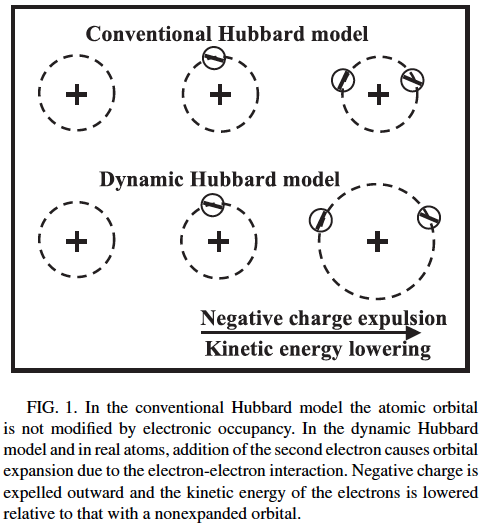
Dynamic Hubbard model: kinetic energy driven charge expulsion, charge inhomogeneity, hole superconductivity, and Meissner effect, arXiv:1302.4178 (2013), Physica Scripta 88, 035704 (2013).
Two-site dynamical mean field theory for the dynamic Hubbard model, G.H. Bach, JEH, F. Marsiglio, arXiv:1008.3905 (2010), Phys. Rev. B 82, 155122 (2010).
Dynamic Hubbard Model: Effect of Finite Boson Frequency , F. Marsiglio, R. Teshima, JEH, cond-mat/0307594 (2003).
Electronic dynamic Hubbard model: exact diagonalization study , cond-mat/0207369 (2002), Phys.Rev. B67, 035103 (2003).
Quasiparticle undressing in a dynamic Hubbard model: exact diagonalization study , cond-mat/0205006 (2002), Phys.Rev. B66, 064507 (2002).
Quantum Monte Carlo and exact diagonalization study of a dynamic Hubbard model , cond-mat/0201005 (2002), Phys.Rev. B65, 214510 (2002).
Why holes are not like electrons: A microscopic analysis of the differences between holes and electrons in condensed matter , Phys.Rev. B 65, 184502 (2002), cond-mat/0109385 (2001).
Dynamic Hubbard Model , Phys. Rev. Lett. 87, 206402 (2001).
Superconductivity from Undressing. II. Single Particle Green's Function and Photoemission in Cuprates , cond-mat/0007328, Phys.Rev.B 62, 14498 (2000)
Superconductivity from Undressing , cond-mat/0007115, Phys.Rev.B 62, 14487 (2000)
Inapplicability of the Hubbard model for the description of real strongly correlated electrons , Physica B 199&200, 366 (1994)
Superconductors that change color when they become superconducting, , Physica C 201, 347 (1992).
Pairing of holes in a tight binding model with repulsive Coulomb interactions , Phys.Rev. B43, 11400 (1991).
Superconductivity in an oxygen hole metal , JEH and F. Marsiglio , Phys.Rev. B41, 2049 (1990).
Effective interactions in an oxygen hole metal , JEH and S. Tang, , Phys.Rev. B40, 2179 (1989).
Hole superconductivity in oxides , JEH and S. Tang, Sol.St. Comm. 69, 987 (1989).
Hole superconductivity , Phys.Lett. A 134, 451 (1989).
The following papers describe
work by others on dynamic Hubbard models and related models:
Interacting electrons in the solid state: the role of orbital relaxation, by A. Fortunelli and A. Painelli, Chem. Phys. Lett., 214, 402 (1993)
Charge states of strongly correlated 3d oxides: from typical insulator to unconventional electron-hole Bose liquid , by A.S. Moskvin, Low Temp. Phys. 33, 234 (2007).
Sign change of the extended s-wave pairing vertex in the dynamic Hubbard model: A quantum Monte Carlo study, by Bouadim, K ; Enjalran, M ; Hebert, F ; Batrouni, GG ; Scalettar, RT, Phys. Rev. B77, 014516 (2008).
Electron-Hole Asymmetry in the Dynamic Hubbard Model, by Bach, G. H.; Marsiglio, F., JOURNAL OF SUPERCONDUCTIVITY AND NOVEL MAGNETISM Volume: 24 Issue: 5 Pages: 1571-1575 (2011).
Optical conductivity for a dimer in the dynamic Hubbard model, by Bach, G. H.; Marsiglio, F., Phys. Rev. B Volume: 85, 15513 (2012)
Dynamical mean field theory for the Dynamic Hubbard model, by G. H. Bach, Thesis, University of Alberta, 2011.
Dynamical screening effects in correlated materials: Plasmon satellites and spectral weight transfers from a Green's function ansatz to extended dynamical mean field theory, by M. Casula, A. Rubtsov and S. Biermann, Phys. Rev. B Volume:85, 035115 (2012).
Optical Properties of a Vibrationally Modulated Solid State Mott Insulator, by S. Kaiser, S. R. Clark, D. Nicoletti, G. Cotugno, R. I. Tobey, N. Dean, S. Lupi, H. Okamoto, T. Hasegawa, D. Jaksch & A. Cavalleri, Scientific Reports 4, Article number: 3823 doi:10.1038/srep03823 (2014).
Mott transition in the dynamic Hubbard model within slave boson mean-field approach,by Duc-Anh Le, Mod Phys Lett B 28, No. 10, 1450078 (2014).
A Multiorbital DMFT Analysis of the Dynamic Hubbard Model ,by C. J. A. Polachic University of Alberta libraries (2015).
Effective doublon and hole temperatures in the photo-doped dynamic Hubbard model, by Philipp Werner, Martin Eckstein, Struct. Dyn. 3, 023603 (2016).
For more information see our web pages on
hole superconductivity
and on
superconductivity from undressing